
How to Write a Scholarship Motivation Letter: Step-by-Step Guide to Winning Scholarship Applications

You can have excellent grades, relevant work experience and a genuine reason for wanting to study abroad, and still submit a scholarship application that fails to convince the selection committee. One of the reasons is often hiding in plain sight: how to write a motivation motivation letter.

A strong scholarship motivation letter does not simply tell the committee that you “deserve” the scholarship. It shows who you are, what has shaped your academic and career direction, why this particular opportunity matters to you, and what you intend to do with it. More importantly, it connects those pieces into a believable story.

This comprehensive guide, you will learn exactly how to write a scholarship motivation letter from the first sentence to the final edit. What to include, how to structure your argument, how to make your experiences sound convincing without exaggerating them, what scholarship committees actually want to see, and how to avoid the mistakes that make otherwise promising applications forgettable.

Table of Contents

What a Scholarship Motivation Letter is

A scholarship motivation letter is a written statement that explains why you are applying for a scholarship and why you are a suitable candidate for the opportunity.

Depending on the scholarship provider, it may be called a motivation letter, motivation statement, personal statement, scholarship essay, scholarship statement, statement of purpose or another similar name. The terminology is not always consistent, so the instructions attached to your particular scholarship should take priority.

For example, DAAD guidance describes the motivation letter as a separate application document where applicants explain, in their own words, why they want to pursue their proposed study or project and why the chosen institution or country is relevant to their plans. Some DAAD programmes specify a maximum length of one to three pages, while individual scholarship calls can impose different requirements.

So, there is no universal scholarship motivation letter template that magically works for every award.

There is, however, a reliable way to think about the document:

  • Your background: What experiences have prepared you for this opportunity?
  • Your motivation: Why do you want to study this subject or pursue this opportunity?
  • Your fit: Why are you a strong candidate for this particular scholarship?
  • Your direction: What do you intend to do with the knowledge, training or network you gain?
  • Your impact: How will the opportunity contribute to something beyond simply obtaining a degree?

A good letter brings these answers together without sounding like a checklist.

Purpose of a Scholarship Motivation Letter and why it’s Important

Your academic transcript already tells the committee your grades. Your CV can show your work experience, leadership roles, internships, volunteering and other activities. Your certificates can prove your qualifications.

So why ask you to write another document?

Because numbers and documents do not always explain the person behind the application.

A motivation letter gives you room to connect the dots. It allows the selection committee to understand why you made certain academic choices, how your experiences influenced your goals, what problem you want to solve and why the scholarship fits into that journey.

Oxford’s guidance for postgraduate applicants, for example, says that a personal statement may explain how personal motivations, experiences and values contributed to an applicant’s decision to apply, while a statement of purpose tends to place greater emphasis on academic background, research interests and career objectives. The exact balance depends on the course.

Scholarship committees can also be looking for something beyond academic ability.

The University of Cambridge’s Mastercard Foundation Scholars Program, for instance, asks applicants to address their education and career history, leadership potential, how the scholarship will help them achieve their goals and how they hope to contribute to sustainable futures in Africa.

That should be able to tell you that the scholarship is not simply investing in your education; it may be investing in what you intend to do with that education.

What a Scholarship Motivation Letter usual Include

Before you start writing, understand the main ingredients of a persuasive motivation letter.

READ ALSO Chevening Scholarships UK 2026/2027: Powerful Benefits & How to Win Fully Funded Admission

Section What to explain What the reader should understand
Opening Your central motivation and direction Why this application matters to you
Academic background Relevant education, projects, subjects or achievements How your academic path prepared you
Relevant experience Work, volunteering, research, leadership or community activities What you have actually done, not just what you claim
Why this programme Specific features of the course, institution or opportunity That you have researched the opportunity
Why this scholarship Connection between the scholarship’s purpose and your goals Why you are a suitable recipient
Future plans Short-, medium- and long-term goals What you intend to do after the opportunity
Impact How you intend to apply what you learn Why supporting you could create wider value
Closing A concise final argument Why your application makes sense as a whole


Step-by-step How to write a scholarship motivation letter

How to write a scholarship motivation letter

step 1.Read the Scholarship Requirements Before Writing Anything

This sounds obvious, but it is one of the easiest ways to weaken a good application.

Do not start with “Dear Scholarship Committee” and hope the rest will come to you.

First, find the official scholarship instructions and identify exactly what the provider is asking you to address.

Look for:

  • the exact essay or motivation-letter question;
  • the maximum or minimum word count;
  • whether the letter should be uploaded as a document or written directly into an application form;
  • whether the scholarship requires a particular format;
  • whether you need to discuss financial need;
  • whether leadership or community service is part of the selection criteria;
  • whether you need to explain your choice of university or course;
  • whether career plans or post-study impact are specifically requested;
  • any restrictions concerning artificial intelligence or external editing.

Do not assume that a 1,000-word personal statement for one scholarship can simply be recycled into a 500-word motivation letter for another.

READ ALSO Factory Jobs in UK with Visa Sponsorship: £20,000–£30,000 Annually + How to Apply

Oxford explicitly advises applicants that requirements vary between programmes, while some Oxford scholarship applications specify their own word counts and questions.

Chevening takes this even further. Its application criteria are built around specific areas including leadership and influencing, networking, course and university choice, and career planning. As an applicant, you therefore need to provide evidence that answers those particular criteria rather than submitting a shallow statement about wanting to study in the United Kingdom.

Step 2: Research the Scholarship Provider

This is the part many applicants usually skip, and it affects them negatively.

Before writing your motivation letter, spend time on the scholarship provider’s official website. Read the scholarship’s objectives, eligibility requirements, selection criteria, programme description and information about previous scholars where available.

You are trying to answer one question:

What does this organisation appear to care about?

Perhaps it prioritises leadership. Or wants applicants committed to development in their home countries. Maybe it is focused on women in STEM, climate resilience, public health, entrepreneurship, academic excellence, international cooperation or a particular region.

Your job is not to pretend to have interests that you do not have. Instead, identify the genuine overlap between what the scholarship supports and what you have already been doing or intend to do.

For example, the Mastercard Foundation Scholars Program at Cambridge currently highlights leadership development and sustainable futures in Africa. An applicant whose academic and professional plans involve climate adaptation, sustainable agriculture, renewable energy or another relevant area can therefore make a stronger case by explaining the connection with concrete evidence.

The difference is subtle but very important.

Step 3: Understand What the Scholarship Is Actually Selecting For

A common mistake is writing a letter that proves you are an excellent student when the scholarship is actually looking for leadership, service, research potential or measurable impact.

Academic excellence matters, but it is not always the only factor.

Chevening, for example, asks applicants to demonstrate leadership and influencing skills through examples with clear results. It also assesses networking, course choice and career plans.

Cambridge’s Mastercard Foundation Scholars Program asks applicants to discuss leadership potential, educational and career history, the role of the scholarship in their aspirations and their contribution to sustainable futures in Africa.

That means you should create a simple list before drafting your letter:

  • What are the scholarship’s stated selection criteria?
  • Which of my experiences demonstrate each criterion?
  • What evidence can I provide?
  • What result came from that experience?
  • How does that experience connect to my future plans?

Notice the emphasis on evidence.

Anyone can write “I am a natural leader.” The committee will learn much more from a sentence explaining how you organised a student project, convinced people to participate, solved a problem and achieved a measurable result.

Step 4: Find the Experiences That Actually Belong in Your Letter

You probably have more experiences than you realise. Write about them and do not limit yourself to formal employment.

You can consider:

  • university research projects;
  • academic competitions;
  • student organisations;
  • volunteering;
  • community projects;
  • internships;
  • part-time work;
  • entrepreneurial projects;
  • professional responsibilities;
  • leadership positions;
  • teaching or mentoring;
  • public-interest projects;
  • technical projects;
  • research publications;
  • professional certifications;
  • challenges you overcame while pursuing your education.

Then ask yourself which experiences actually support the story you are trying to tell.

You do not need to mention everything you have ever done.

A motivation letter is not your CV rewritten in paragraph form.

Step 5: Turn Your Experiences Into Evidence

This is where a good scholarship letter starts separating itself from a generic one.

Instead of merely naming an experience, explain what happened, what you did and what changed because of your involvement.

A useful structure is:

Situation → Action → Result → Lesson → Future connection

For example:

Situation: “During my final year, I noticed that students in my department struggled to access practical programming resources.”

Action: “I organised weekly peer-learning sessions and created a shared repository of beginner-friendly exercises.”

Result: “The sessions eventually attracted students from three departments, and participants used the materials to complete their final-year projects.”

Lesson: “The experience showed me that access to technical knowledge can be as important as having an interest in technology.”

Future connection: “It strengthened my interest in developing scalable digital-learning systems for students with limited access to practical computing resources.”

That is much stronger than saying:

“I have excellent leadership skills and I am passionate about technology.”

Step 6: Explain Why You Chose the Course

If the scholarship is connected to a particular degree or academic programme, your motivation letter should make the connection clear.

Do not simply write that the university is prestigious.

The committee already knows that.

Instead, research the programme and identify specific academic features that matter to your goals. These might include particular modules, research areas, laboratories, teaching approaches, field opportunities, interdisciplinary components, faculty expertise or industry connections.

Oxford’s application guidance repeatedly asks applicants to explain their motivation for a particular course and demonstrate an understanding of the subject or programme.

For instance:

Non specific: “I chose this programme because it is one of the best programmes in the world.”

Specific: “The programme’s combination of [module/topic] and [module/topic] is particularly relevant to my goal of working on [specific problem]. My previous experience with [project/work] exposed me to [specific gap], and I want to develop stronger expertise in [specific area] so I can address it more effectively.”

One sentence tells the committee that you searched the university’s ranking.

The other tells them that you researched the programme.

Step 7: Explain Why You Need the Scholarship

This section requires some care.

If the scholarship asks you to explain financial need, answer the question directly. If it does not, do not turn your entire motivation letter into a financial hardship statement.

Being unable to afford international tuition can be a legitimate part of your story, but financial need alone does not necessarily explain why you are the right person for a competitive scholarship.

Instead, connect financial support to the opportunity itself.

For example, you might explain that the scholarship would make it possible for you to undertake a programme that would otherwise be financially inaccessible, while the skills gained would help you pursue a clearly defined professional or community objective.

Be honest. Do not manufacture hardship because you think every scholarship committee wants a dramatic story.

A calm, truthful explanation is usually more convincing than exaggerated suffering.

Step 8: Connect the Scholarship to Your Career Goals

This is one of the most important sections of a scholarship motivation letter, particularly when the scholarship provider asks about future impact.

Try to move beyond:

“After graduation, I hope to get a good job and contribute to my country.”

That could describe almost any applicant.

Instead, think in three stages:

  • Short term: What do you want to do immediately after the programme?
  • Medium term: What position, project or area do you want to develop over the next few years?
  • Long term: What larger problem do you ultimately want to help solve?

Chevening’s current criteria specifically ask applicants to demonstrate short-, mid- and long-term career plans with clear, measurable goals.

Your plan does not need to predict your entire life. It needs to be credible.

If you are applying for a master’s degree in public health, for example, do not suddenly claim that you will transform the entire healthcare system within two years of graduation. Explain the realistic step you intend to take first, and then show how that step fits into a larger ambition.

Step 9: Show the Impact You Want to Make

Scholarship committees often want to know what happens after they invest in you.

That does not mean you need to promise something extraordinary.

Impact can take many forms.

You might return to your country and work in your field. You might build a company, conduct research, develop policy, teach other students, improve a community service, create employment, contribute to an organisation or use specialised knowledge to solve a problem in your industry.

The key is specificity.

Instead of writing:

“I want to give back to my community.”

Ask:

Give back how?

Who would benefit?

What would you actually do?

Why does your proposed education make you better equipped to do it?

That is the level of thinking a strong motivation letter should demonstrate.

Step 10: Write an Opening That Gives the Reader a Reason to Continue

Your first paragraph matters because it establishes the direction of the entire letter.

But you do not need a dramatic childhood story.

You also do not need to begin with a dictionary definition.

Avoid openings such as:

“Education is the key to success.”

“Since I was a child, I have always dreamed of studying abroad.”

“In today’s rapidly changing world, education plays an important role.”

These sentences are not necessarily false. They are simply too broad to tell the reader anything interesting about you.

A better opening usually begins with a specific experience, problem, question, academic interest or professional observation that explains where your motivation comes from.

For example:

“During my final year studying agricultural science, I began to notice a pattern in the communities where I completed my fieldwork: farmers were not necessarily lacking the willingness to adopt new practices, but they often lacked reliable access to the information and technical support needed to do so.”

Now the reader has a reason to ask what happened next.

That is what your opening should accomplish.

How to Structure a Scholarship Motivation Letter

There is no single structure required by every scholarship, but the following framework works well when the scholarship’s instructions are relatively open.

Paragraph 1: Your motivation

Introduce the central reason you are applying. Give the reader enough context to understand the problem, experience or academic interest that led you here.

Paragraph 2: Your academic preparation

Explain the parts of your education that are directly relevant to the proposed programme. Mention meaningful projects, subjects, research or academic achievements rather than listing every course you have taken.

Paragraph 3: Your relevant experience

Show how you have applied your knowledge outside the classroom. Use one or two strong examples and explain the results or lessons.

Paragraph 4: Why this programme

Explain why the specific course, university or scholarship opportunity fits your goals. Mention details you have researched.

Paragraph 5: Why you are a strong scholarship candidate

Connect your experiences to the scholarship’s selection criteria. If leadership, service, research or entrepreneurship matters, provide evidence.

Paragraph 6: Your future plans

Explain what you intend to do after the programme and how the knowledge or network gained will help you move toward that goal.

Paragraph 7: Your closing argument

Bring the story together. Do not introduce a completely new achievement at the end. Reinforce the connection between your past, the opportunity and the impact you intend to make.

Related Article How to Apply for Visa Sponsorship Programs: A Complete Guide for International Applicants

How Long Should a Scholarship Motivation Letter Be?

There is no universal length.

The scholarship provider’s instructions always come first.

Some programmes request a one-page statement. Others may permit two pages or specify a word count such as 500, 750 or 1,000 words. DAAD scholarship calls, for example, can specify different limits depending on the programme, while Oxford course applications also have programme-specific requirements. DAAD’s general guidance says some motivation letters should be between one and three pages, while individual scholarship calls can specify their own limits.

If no word count is given, keep the letter focused rather than trying to make it as long as possible.

A 700-word letter with a clear argument is usually more useful than 1,500 words of explanation that makes no sense.

Before submitting, as yourself:

  • Have I answered every part of the prompt?
  • Have I repeated the same idea?
  • Does every paragraph add something new?
  • Have I spent too much space describing my childhood?
  • Have I explained what I actually did rather than just what I believe?
  • Have I connected my experience to my future plans?

How to Write a Scholarship Motivation Letter for a Master’s Degree

How to write a scholarship motivation letter for a Master's degree
How to write a scholarship motivation letter for a Master’s degree…


A master’s scholarship motivation letter should usually demonstrate a stronger academic direction than an undergraduate application.

You should be able to explain why you need advanced study and how the proposed programme fits into your academic or professional development.

Discuss:

  • your undergraduate field;
  • relevant academic projects or research;
  • professional experience where applicable;
  • the specific area you want to develop;
  • why postgraduate study is the appropriate next step;
  • why this programme is relevant;
  • your intended career direction.

DAAD’s own guidance recommends explaining your educational background, skills, professional experience where applicable, academic motivation and reasons for choosing the proposed programme.

READ ALSO Top Paying Caregiver Jobs in the USA with Visa Sponsorship 2026/2027 $33k–$70k Annually + How to apply

How to Write a Scholarship Motivation Letter for PhD Applications

A PhD scholarship motivation letter usually needs a more research-oriented argument.

Your academic background, research experience, proposed research direction and reasons for choosing the programme may carry more weight than general statements about personal development.

If the application requires a separate research proposal, do not simply duplicate the proposal in your motivation letter.

Instead, explain the intellectual journey behind your interest.

For example, you can discuss:

  • how your previous research led you to the current question;
  • what problem or gap interests you;
  • why further research is necessary;
  • why the proposed institution or research environment is appropriate;
  • what skills you need to develop;
  • how the research fits into your longer-term academic or professional plans.

DAAD scholarship guidance similarly asks applicants to explain their academic and personal reasons for the proposed study or research project, including what they hope to gain from the experience personally, professionally and for their career.

How to Write a Scholarship Motivation Letter Without Work Experience

Not having extensive professional experience does not automatically make you a weak scholarship applicant.

If you are a recent graduate or undergraduate applicant, focus on evidence from the experiences you do have.

That could include academic projects, research, volunteering, student leadership, community activities, internships, competitions, personal projects or responsibilities you have taken on.

The mistake is trying to sound more experienced than you are.

Do not write as though you have managed a multinational organisation when you coordinated a student association project. The smaller experience can still demonstrate leadership if you explain what you did and what happened because of it.

How to Explain Leadership in a Scholarship Motivation Letter

Leadership is often misunderstood as holding a formal title.

You do not necessarily need to have been a company director, student union president or project manager.

Leadership can also involve identifying a problem, organising people, taking responsibility, influencing a decision, mentoring others or turning an idea into a working project.

Chevening’s current application guidance specifically looks for evidence of leadership and influencing skills, professional relationships and a realistic career plan for creating positive change.

So instead of writing:

“I am an excellent leader.”

Tell the story.

What the situation was, what you did, who you influence, the resistance you encounter, what changed, and what you learned.

That is evidence of leadership.

How to Explain Community Service or Volunteering

If community service is relevant to the scholarship, do not simply list organisations and dates.

Explain why you became involved and what you actually contributed.

For example, compare these two approaches:

Weak: “I volunteered with several organisations and helped my community.”

Better: “In 2025, I volunteered with a community literacy project that supported secondary-school students preparing for examinations. I initially helped with mathematics lessons, but after noticing that attendance dropped when students struggled with transportation costs, I worked with the coordinators to reorganise the sessions around existing community meeting days. The change improved attendance and taught me that solving an educational problem sometimes requires addressing the practical barriers around it.”

The second example gives the activity a purpose.

How to Write About Financial Hardship Without Sounding Manipulative

Financial difficulty can be a genuine part of your scholarship story, particularly when the scholarship specifically considers financial need.

However, you should not turn the motivation letter into an emotional appeal built entirely around hardship.

Explain the situation honestly, then connect it to the opportunity.

For example, rather than spending half the letter describing how expensive international education is, explain what financial support would make possible and why that opportunity is relevant to your academic and professional plans.

Should You Mention Your Country in a Scholarship Motivation Letter?

Yes, when it is relevant to your goals.

This can be particularly useful for international scholarships that expect scholars to contribute to their home communities or countries after graduation.

But avoid turning your country into a collection of vague statements about “developing nations” or “Africa’s problems.”

Be specific.

If you are from Nigeria, for example, you might discuss a particular challenge in your sector, community or professional field and explain how your proposed education could help you contribute to solving it.

The same principle applies to applicants from Ghana, Kenya, South Africa, Uganda, Rwanda, India, Bangladesh or any other country.

Your nationality is not your argument.

Your experience and proposed contribution are.

How to Make Your Scholarship Motivation Letter Personal

Making your scholarship motivation letter personal does not mean revealing every difficult experience you have ever had.

It means the reader should be able to recognise your reasoning.

Details make a statement personal.

Instead of saying you became interested in public health “because healthcare is important,” explain the experience that made you pay attention to a particular health issue.

Rather than saying you love computer science, explain the project that made you realise you wanted to work in a particular area of computing.

Also explain what you have already done with or for young people rather than just saying you want to help young people

Your story does not have to be extraordinary.

It has to be yours.

How to Write a Strong Scholarship Motivation Letter Introduction

A useful opening formula is:

Specific experience + what it revealed + where it led you.

For example:

“When I began working with small business owners in my community, I expected their biggest challenge to be access to capital. Instead, I repeatedly encountered another problem: many of them struggled to interpret basic financial information and make decisions about pricing, cash flow and reinvestment. That experience changed the direction of my interest in finance and motivated me to pursue advanced training in financial management.”

Notice what this opening does.

It starts with an experience. It introduces a problem. It shows a change in thinking. Then it creates a natural reason for further study.

How to Write the Body of a Scholarship Motivation Letter

The body should answer the questions raised by the opening.

If you introduce a problem, explain how your education and experience have prepared you to address it.

You introduce an academic interest, show where that interest came from and what you have done to explore it.

A career goal, demonstrate why you are moving in that direction.

Every paragraph should earn its place.

How to End a Scholarship Motivation Letter

Your final paragraph should not suddenly become more dramatic than the rest of the letter.

Bring the argument together.

You can briefly reinforce:

  • your motivation;
  • your fit with the scholarship;
  • your academic or professional direction;
  • what you intend to contribute after the programme.

Then end with confidence.

You do not need to beg the committee to select you.

Something as simple as this can work:

“This scholarship would give me the academic training and international exposure needed to take the next step in my professional development. More importantly, it would strengthen my ability to contribute to [specific field/problem] through [specific future action]. I therefore see the opportunity not simply as a means of obtaining another qualification, but as a practical step toward the work I intend to pursue after graduation.”

The exact wording should, of course, reflect your own story.

Scholarship Motivation Letter Example

The following example is deliberately fictional. It is intended to demonstrate structure and reasoning rather than provide text to copy into an application.

Example: Master’s Scholarship Motivation Letter

During my final year studying environmental science, a fieldwork project changed the way I understood climate-related challenges in my community. I had expected to focus mainly on environmental conditions, but I became increasingly interested in the decisions that determine whether communities can prepare for those conditions. In the communities we visited, residents were often aware of changing weather patterns but had limited access to reliable information and practical adaptation strategies. That experience strengthened my interest in climate policy and motivated me to pursue advanced study in this area.

My undergraduate training gave me a foundation in environmental assessment, data analysis and sustainable development. For my final-year project, I examined [specific research topic], which required me to collect and analyse [specific data]. The project improved my technical skills, but it also exposed a gap in my knowledge. I could identify environmental trends, yet I wanted to understand more deeply how policy, financing and institutional decisions influence the response to those trends.

Since graduating, I have sought opportunities to develop this interest beyond the classroom. Through my work with [organisation/project], I have contributed to [specific responsibility]. One experience that particularly influenced me involved [specific project]. I was responsible for [action], and the project resulted in [specific outcome]. More importantly, it showed me that technical knowledge has limited value when it cannot be translated into decisions that people and institutions can implement.

I am particularly interested in [specific programme] because of its focus on [specific module/research area]. The programme’s combination of [feature] and [feature] aligns closely with the areas I now want to develop. I am especially interested in studying [specific topic] because of its relevance to [specific problem in home country/region].

The scholarship would make it possible for me to undertake this training while giving me access to an international academic environment in which I can learn from researchers and students working on related challenges in different contexts. I would bring to the programme my experience of working on [specific issue], as well as the perspective of someone who has seen the practical consequences of [specific problem] in my community.

After completing the programme, I intend to return to [country] and work in [sector/role], initially focusing on [specific objective]. In the medium term, I hope to contribute to [specific policy/project/organisation]. My longer-term goal is to help develop and implement evidence-based approaches to [specific problem]. The knowledge, research skills and professional network gained through this scholarship would be important in moving toward those goals.

I see this scholarship as more than financial support for a master’s degree. It would provide the training and environment necessary to turn an interest that began during my undergraduate fieldwork into a more focused professional contribution. I am prepared to make full use of that opportunity and to apply what I learn to the challenges I hope to address in my home country.

Why this example works: It does not claim that the applicant is extraordinary. Instead, it gives the reader a logical chain: experience → academic interest → further experience → programme choice → scholarship fit → future contribution.

Bad Scholarship Motivation Letter vs Good Scholarship Motivation Letter

Weak approach Stronger approach
“I have always dreamed of studying abroad.” Explain the specific academic or professional reason international study is relevant to your goal.
“I am a hardworking person.” Give an example that demonstrates persistence or responsibility.
“I am passionate about leadership.” Describe a situation where you led, influenced or organised others and explain the result.
“This is a prestigious university.” Explain which parts of the programme are relevant to your goals.
“I want to give back to my country.” Explain what you intend to do, who will benefit and how your education contributes.
“I need this scholarship because tuition is expensive.” Explain the financial barrier honestly and connect the support to your academic and career plans.
Listing ten achievements Develop two or three relevant achievements with evidence and reflection.
Using impressive vocabulary Using clear language that sounds like a real person.

Common Scholarship Motivation Letter Mistakes to Avoid

A scholarship motivation letter can look polished and still fail to make a strong impression. In many cases, the problem is not poor English or a lack of achievements. It is that the applicant has spent too much time trying to sound impressive and not enough time showing the committee who they actually are.

Here are the mistakes worth checking before you submit.

1. Starting With a Cliché

“Education is the key to success.”

“Since I was a child, I have always dreamed of studying abroad.”

“I have always been passionate about making a difference in the world.”

There is nothing inherently wrong with these statements. The problem is that thousands of applicants can write the same thing.

Your opening should give the reader something specific about you. A particular experience, problem, academic discovery or professional observation will usually create a stronger beginning than a quotation about success.

2. Repeating Your CV

Your motivation letter should not be your CV written in complete sentences.

If your CV already says that you worked as a research assistant from 2024 to 2025, the motivation letter should explain what that experience taught you, how it influenced your goals or what problem it exposed you to.

The CV gives the committee the facts. Your motivation letter should provide the reasoning behind those facts.

3. Writing One Generic Letter for Every Scholarship

This is one of the biggest shortcuts that can weaken an otherwise strong application.

A scholarship focused on leadership may want evidence of how you influence people and create change. A research scholarship may be much more interested in your academic direction and research potential. A development-focused scholarship may ask how you intend to use your education to contribute to your community or country.

Those applications should not sound identical.

You can reuse genuine experiences from your own life, but the way you present them should reflect the specific scholarship and its selection criteria.

4. Making Big Claims Without Evidence

“I am an exceptional leader.”

“I am highly innovative.”

“I have excellent communication skills.”

These claims are easy to make because nobody has to prove them while typing.

The better approach is to demonstrate the quality through an experience.

If you claim to be a leader, describe a situation in which you took responsibility, influenced people, solved a problem or achieved a result. If you claim to be innovative, explain what you created or changed and why it mattered.

Let the evidence do the bragging for you.

5. Ignoring the Scholarship’s Selection Criteria

Before writing, identify what the scholarship actually values.

If the official criteria mention leadership, community engagement, academic excellence, career development or impact, your letter should provide evidence relevant to those areas.

Chevening, for example, evaluates areas including leadership and influencing, relationship-building, course and university choice, and career planning. An applicant who spends almost the entire essay discussing academic grades without addressing those areas would be leaving important parts of the application unanswered.

6. Being Vague About Your Future

“I want to become successful and give back to my country.”

It sounds positive, but what does it actually mean?

What career do you want?

Which problem do you want to work on?

Who will benefit?

What will you do after graduation?

A scholarship committee does not expect you to predict every detail of your future. However, you should have a reasonable direction.

A much stronger career statement identifies the sector or role you want to enter, the problem you want to address and the steps you intend to take after completing your studies.

7. Exaggerating Financial Hardship

Financial need can be an important part of a scholarship application, but turning your entire motivation letter into an emotional story about poverty can work against you.

If the scholarship asks about financial circumstances, answer honestly. Explain the actual barrier and what receiving the scholarship would make possible.

Do not invent hardship, exaggerate your circumstances or present ordinary financial challenges as something they are not.

A credible application does not need manufactured drama.

8. Trying Too Hard to Sound Intelligent

Some applicants believe that sophisticated vocabulary will make their application look more academic.

Usually, the opposite happens when the language becomes unnatural.

You do not need to write sentences such as:

“The multifaceted ramifications of my academic trajectory have precipitated an inexorable desire to leverage interdisciplinary competencies…”

Unless that is genuinely how you communicate, it will sound forced.

Clear writing is not simple-minded writing. In a competitive application, being able to communicate a complex idea clearly is an advantage.

9. Ignoring the Word Limit

If a scholarship asks for 500 words, treat 500 words as a real requirement rather than a suggestion.

Some applications impose strict limits, while others give applicants a range or page limit. Follow the instructions for the particular scholarship.

When you have too much to say, do not simply reduce the font size or squeeze everything into longer sentences. Decide which experiences actually strengthen your argument and remove the rest.

10. Submitting an AI-Generated Letter as Your Own

This deserves special attention because scholarship providers do not all have the same rules about artificial intelligence.

For example, Chevening currently states that applicants must write their answers in their own words and that using AI-generated answers in the application is prohibited.

How to Make Your Scholarship Motivation Letter Sound Natural

One of the easiest ways to improve your letter is surprisingly simple: read it aloud.

When you read silently, your brain tends to fill in awkward wording. Reading aloud removes some of that protection.

You may suddenly notice that three paragraphs begin with “I am.” You may hear a sentence that is four lines long. You may discover that you have used “passionate” five times.

Fix those things.

Replace vague statements with specific details. Remove unnecessary adjectives. Combine paragraphs that repeat the same point. Break up sentences that have become difficult to follow.

Most importantly, do not edit all of your personality out of the letter.

A scholarship motivation letter should sound professional, but it should still sound like a person wrote it.

How to Edit Your Scholarship Motivation Letter Before Submitting

Do not submit your first complete draft.

Give yourself enough time to come back to it with fresh eyes.

During the first editing round, focus on the argument. Ask whether the letter actually answers the scholarship question and whether the paragraphs follow a logical order.

During the second round, look for repetition. If you have already explained that you want to improve education in your country, you do not need to say the same thing three more times using different words.

During the final round, check grammar, spelling, names, dates, programme titles and word count.

Also check every fact.

If you mention a university module, research centre, scholarship objective or programme feature, make sure it actually exists and is relevant to the current application cycle.

A small factual mistake can make an otherwise carefully prepared application look careless.

Scholarship Motivation Letter Checklist Before Submission

Before clicking the submit button, go through this checklist.

  • Have I read the official scholarship instructions?
  • Have I answered the exact question?
  • Have I stayed within the required word count?
  • Have I explained why I want the programme?
  • Have I explained why this particular scholarship is relevant to my plans?
  • Have I provided evidence of my strengths rather than simply naming them?
  • Have I included relevant academic or professional experience?
  • Have I explained my future plans clearly?
  • Have I shown what I intend to contribute?
  • Have I avoided generic motivational quotations?
  • Have I avoided exaggeration?
  • Have I checked the spelling of the university, programme and scholarship name?
  • Have I followed the required formatting instructions?
  • Have I checked whether the scholarship has rules about AI assistance?
  • Does the final version still sound like me?

Frequently Asked Questions About Scholarship Motivation Letters

What is the difference between a motivation letter and a scholarship essay?

The terms are not used consistently by every organisation. A motivation letter generally explains why you want an opportunity and why your background and goals make you a suitable candidate. A scholarship essay may be built around a specific question or several selection criteria.

Because the terminology varies, follow the instructions supplied by the scholarship provider rather than relying on a generic definition.

How many words should a scholarship motivation letter be?

There is no universal word count.

Follow the exact limit given by the scholarship, university or programme. Some applications request a page limit, while others specify a maximum number of words or characters.

If no limit is provided, keep the letter focused and avoid adding paragraphs simply to make it longer.

Can I use the same motivation letter for different scholarships?

You can reuse genuine experiences from your own background, but you should tailor the actual letter to each scholarship.

The selection criteria may be completely different. A research scholarship, leadership scholarship and need-based scholarship may each require a different emphasis.

Should I mention financial problems in my motivation letter?

If the scholarship specifically asks about financial need, answer the question honestly.

If financial need is not part of the prompt, do not allow it to dominate your statement. Explain how the scholarship would remove a financial barrier and connect that support to what you intend to accomplish.

Should I talk about my family background?

You can, provided it is relevant.

A family experience can explain why you became interested in a particular subject, overcame a challenge or developed a particular goal. However, do not include deeply personal information simply because you think emotional stories are automatically more persuasive.

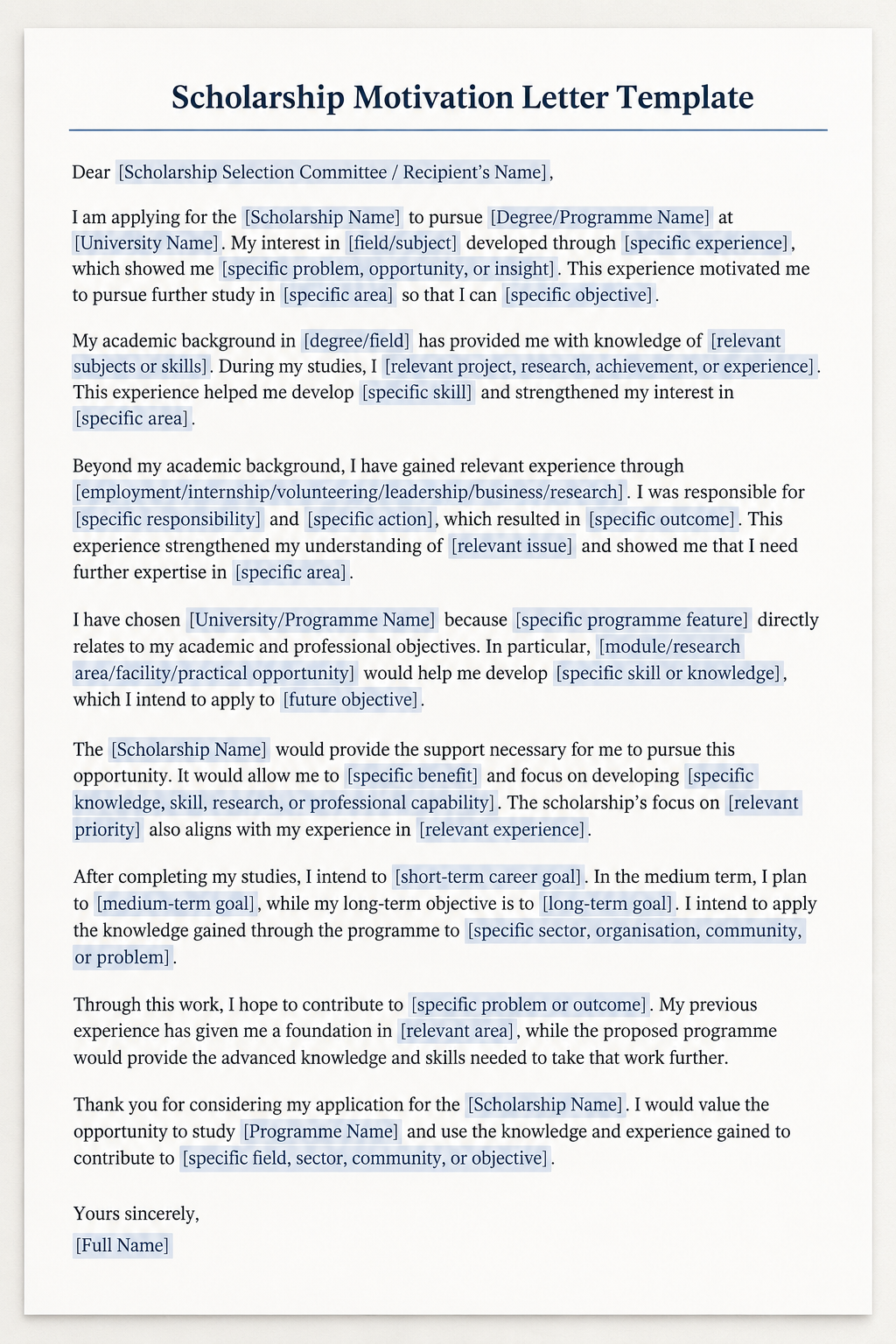
Can I use a scholarship motivation letter template?

Yes, a template can help you understand structure.

However, use it as a framework rather than something to copy. Your motivation letter should contain your experiences, your evidence and your reasoning.

Should a scholarship motivation letter have a title?

Only when the application instructions require one.

If you are uploading a document and no title has been specified, a simple heading such as “Scholarship Motivation Letter” is generally enough.

Should I address the letter to a specific person?

If the scholarship provides the name or title of the appropriate recipient, use it.

If no name is provided, do not guess. A professional general salutation is safer than addressing the wrong person.

Can I mention more than one career goal?

You can, but your goals should make sense together.

If your letter says you want to become a software engineer, international development consultant, medical researcher and entrepreneur immediately after graduation, the committee may struggle to understand your actual direction.

A focused goal is easier to believe.

Do scholarship committees care about grammar?

Clear writing matters, especially when communication is relevant to the scholarship or programme.

However, perfect grammar will not compensate for a weak argument. Your priority should be clear thinking, relevant evidence and a coherent story, followed by careful proofreading.

Can I write about failure in a scholarship motivation letter?

Yes.

A failure can become a useful part of your story when it demonstrates reflection, adaptation or growth.

Do not spend the entire paragraph explaining why the failure was not your fault. Explain what happened, what you learned and what you changed afterwards.

How do I write a scholarship motivation letter if I have low grades?

Do not spend the entire letter apologising for your grades.

If there is a legitimate explanation and the application gives you an opportunity to discuss it, address the issue honestly and briefly. Then focus on evidence of your current ability, academic improvement, relevant experience and readiness for the proposed programme.

What makes a scholarship motivation letter stand out?

Usually, it is not one clever sentence.

Strong letters stand out because they are specific, coherent and believable. They connect the applicant’s past experiences with the proposed programme, the scholarship’s objectives and a realistic future direction.

The committee should finish reading and understand not only what you want, but why you want it and what you intend to do with the opportunity.

Finally,

The strongest scholarship motivation letters are not necessarily written by applicants with the most dramatic stories.

They are written by applicants who understand their own story well enough to explain it clearly.

Your grades show what you have achieved academically. Your CV shows what you have done. Your references provide another person’s perspective on your abilities.

Your motivation letter has a different job.

Do not try to manufacture a perfect applicant on the page. Tell the truth, choose your strongest evidence, follow the scholarship’s instructions and make the connection between your past, your present application and your future direction easy to see.

That is what turns a motivation letter from another required document into a meaningful part of your scholarship application.

Official Scholarship and Application Resources

Resource What you can use it for
Oxford University Careers Service Guidance on personal statements for further study
University of Oxford – Personal Statement and Statement of Purpose Official guidance on graduate application statements
DAAD – Scholarship Application Guidance Official guidance on motivation letters and scholarship applications
Chevening – Application Criteria Official scholarship selection criteria and application guidance

Good luck!


Leave a Comment