

For someone who has genuine caregiving experience, the United States can offer more than just another job. It can provide an opportunity to earn a better income, gain experience in a large healthcare system, and, in some circumstances, pursue an employer-supported immigration pathway.
That is why caregiver jobs in USA with visa sponsorship have become increasingly popular among international job seekers.
There are opportunities across home care, assisted living, nursing facilities, disability support and private-duty care. However, the jobs are not all the same. Some require very little formal training, while others favour candidates with healthcare certifications or specialized experience. The pay can also differ considerably depending on the position, location, schedule and level of responsibility.
For an applicant outside the United States, you should ensure that the employer is actually prepared to consider someone who needs immigration sponsorship.
In this comprehensive guide, we’ve brought all these together so that you can understand the jobs, earning potential, qualifications, sponsorship possibilities and most practical ways to look for them without wasting your time on unsuitable vacancies.
Available Caregiver jobs in the USA
Caregiving is a broad field, and the word “caregiver” can describe several different jobs.
A home health aide may help an older client with bathing, dressing, meals, mobility and other daily activities. A certified nursing assistant may work in a nursing home or healthcare facility under the direction of licensed medical staff. A private-duty caregiver may provide one-on-one support inside a client’s home, while a live-in caregiver may combine personal care with household assistance and companionship.
There are also roles supporting people with disabilities or individuals who need long-term assistance with everyday living.
This difference matters when you are looking for work because if you search only “caregiver jobs”, it can leave useful opportunities out of your search. Someone with healthcare training, for example, may find more suitable positions by searching for CNA, nursing assistant, home health aide or personal care aide.
The U.S. Bureau of Labor Statistics currently lists home health and personal care aides among the country’s very large occupations, with employment projected to grow substantially through 2035. That reflects a genuine need for care workers, particularly as more people require assistance while continuing to live in their homes and communities.
Realistic earning expectations of a caregiving jobs
Caregiver salaries are often presented online without enough context. You may see advertisements claiming that caregivers can make $50,000, $60,000 or even more per year, but that does not mean those figures represent the normal starting salary for the occupation.
The latest U.S. Bureau of Labor Statistics figures put the median annual wage for home health and personal care aides at $35,800, based on May 2025 data. Nursing assistants had a higher median of $42,260.
Those numbers give you a much better starting point when judging an advertisement.
A position paying more money may involve overtime, overnight work, specialized care, a high-cost location or responsibilities that go beyond ordinary personal-care assistance. Therefore, salary should always be considered together with the number of hours you are expected to work.
For an international applicant, it is important you pay much attention to the hourly rate and guaranteed working hours, rather than becoming attracted to the annual salary alone. A $50,000 position with excessive working hours may be less attractive than a lower-paying position with reasonable hours, benefits and a clear employment arrangement.
High-paying caregiver-related positions in USA
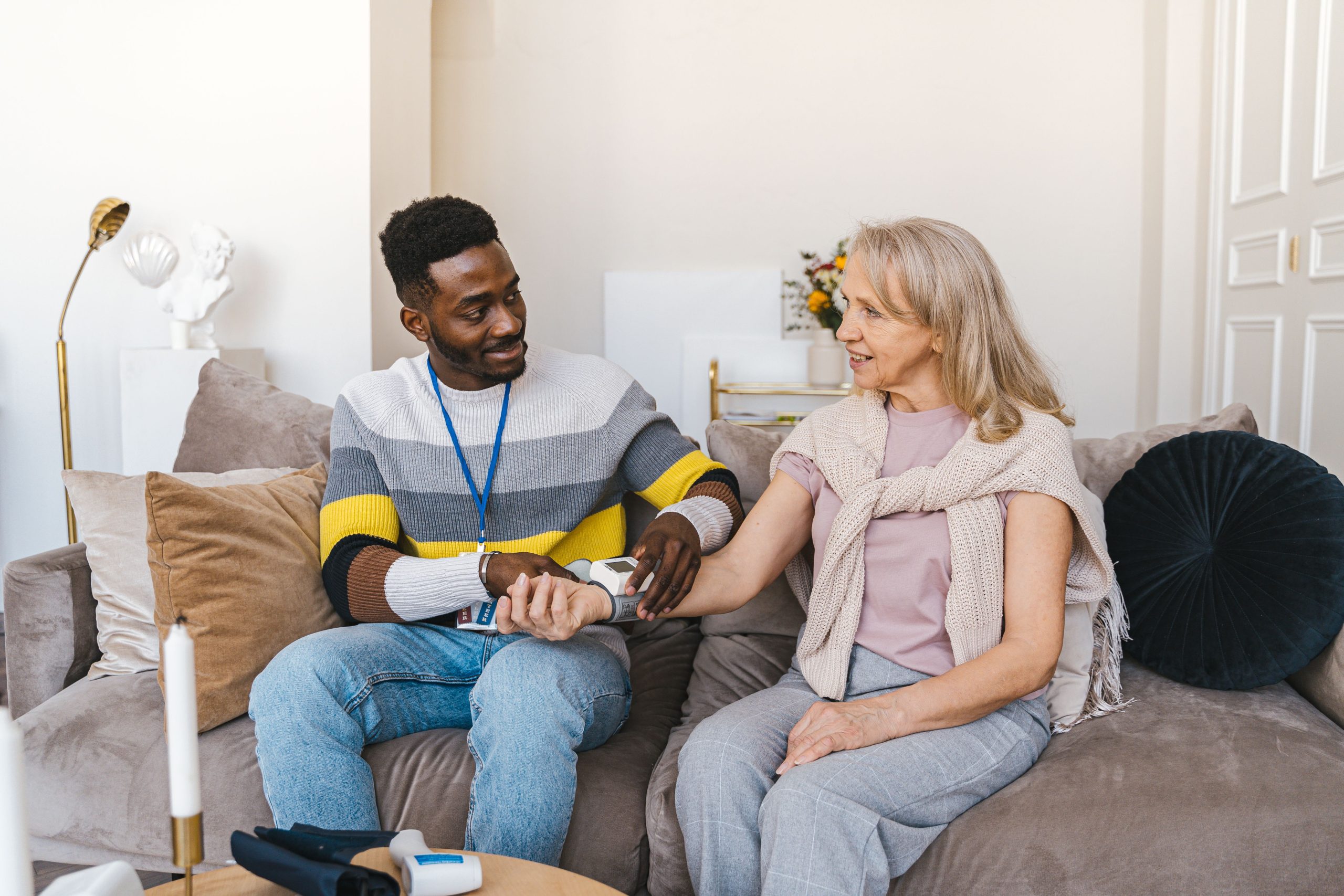 The position mentioned below are one of the high-paying caregiver jobs available in USA for 2026/2027:
Related Posts
Entry-Level Jobs in USA with Visa Sponsorship in 2027 for Foreigners: Requirements & How to Apply
Farm Workers Jobs Abroad with Visa Sponsorships in 2026/2027
Certified Nursing Assistant
Certified Nursing Assistants, or CNAs, occupy a more formal position within the healthcare system than many entry-level caregiver roles.
Depending on the setting, CNAs assist patients with personal hygiene, feeding, movement, positioning and other activities of daily living. They may work in nursing homes, hospitals, assisted-living facilities and other healthcare environments.
The additional training can make CNA work attractive to someone who wants to build a longer-term healthcare career. It can also give an international applicant a more specific professional profile than simply describing themselves as a general caregiver.
Home Health Aide
Home health aides provide support to people in their homes, particularly older people, people with disabilities and individuals living with chronic conditions.
The work is often practical rather than clinical. Depending on the position, you may help with bathing, dressing, meal preparation, mobility, housekeeping related to the client’s care and other everyday activities.
The BLS reports that home health and personal care aides typically receive short-term on-the-job training, although formal requirements can vary according to the employer and care setting.
For someone entering the field, this makes home-care work one of the more accessible areas to explore. For someone seeking sponsorship from abroad, however, the immigration side becomes considerably more important.
Private-duty caregiver
Private-duty caregiving is usually more personal because you may be assigned to one client or family for an extended period.
The responsibilities can include personal care, companionship, mobility assistance, meal preparation and support with daily routines.
Experienced caregivers who are comfortable working independently can sometimes find better-paying private-duty positions. Nevertheless, always examine the working arrangement carefully, particularly where the vacancy involves long shifts or live-in responsibilities.
Specialized older people-care positions
Experience with dementia, Alzheimer’s disease, disability support, mobility limitations or other complex care needs can make a caregiver more competitive.
This is where experience becomes more valuable than simply counting years on a CV.
For example, an applicant who can explain how they supported a client with limited mobility, prevented falls, maintained a medication reminder schedule and communicated changes to the client’s family gives an employer much more useful information than someone who simply writes “five years of caregiving experience.”
Caregiver jobs in USA for foreigners
Foreign applicants can search for U.S. caregiving positions, but there is a difference between finding a job advertisement and finding a job that can actually work for someone who is outside the country.
Many ordinary caregiver vacancies are designed for people who are already legally authorized to work in the United States. An international applicant who needs sponsorship therefore has to examine the vacancy more carefully.
Look for language indicating that the employer considers international candidates or is willing to sponsor qualified workers. If the vacancy specifically says that applicants must already have U.S. work authorization, it is usually not the right opportunity for someone applying from abroad.
This is also why searching for “visa sponsorship” alongside the occupation can be useful, although the search result itself should never be treated as proof that sponsorship is available.
Related Posts
Senior CRM Marketing Associate Remote Job: Complete Career Guide
Remote Appointment Setter Job @ Enviro Resource Management: Requirements & How to Apply
How to find Sponsored Foreign Workers jobs With monthly salary $1k-$3k + How to APPLY
Caregiver jobs in USA for Nigerians
Nigerian caregivers can use the same international recruitment route as other foreign applicants, but the application needs to be built around qualifications and experience rather than simply a willingness to relocate.
If you have worked with older people, patients or people with disabilities in Nigeria, describe the actual responsibilities you performed. Include the type of clients you supported, the length of your experience, your training and the practical tasks you handled.
Relevant certificates such as caregiving training, First Aid or CPR can also strengthen an application.
One thing Nigerian applicants should be particularly careful about is the agent promising a “caregiver visa slot.” A genuine employment opportunity should have an identifiable employer, a real position and a verifiable recruitment process. You should be able to understand what job you are being offered before anyone asks you to commit substantial money.
Qualifications needed for caregiver jobs in the USA
Requirements vary by employer and state, but practical caregiving experience remains one of the most useful assets.
Employers may look for:
- Previous professional caregiving experience
- Home health or personal-care training
- CNA certification where applicable
- CPR or First Aid certification
- Experience with older clients
- Dementia or disability-care experience
- Good communication skills
- Professional references
- A reliable employment history
- The ability to pass required background checks
A university degree is not automatically necessary for basic home-care positions. What matters is whether you meet the requirements of the specific job and, separately, whether you qualify for the immigration route connected to the position.
That second point is important because being qualified to perform a job does not automatically mean that an employer can sponsor you to enter the United States.
Home health aide visa sponsorship in USA
Home health aide positions are among the jobs that international applicants commonly investigate because the occupation has a large workforce and strong long-term demand.
However, demand for workers and availability of visa sponsorship are two different things.
A home-care company can have hundreds of clients and still recruit only people who already have permission to work in the United States. Therefore, when you find a home health aide vacancy, check the employment authorization requirements before spending time on the application.
Some employers may consider sponsorship in particular circumstances, while others explicitly state that sponsorship is unavailable. Current job boards already show both types of listings, which is why the wording of each individual vacancy matters more than a generic claim that “caregiver jobs are sponsored.”
For applicants outside the United States, the ideal vacancy is one where the employer clearly explains its position regarding foreign workers and sponsorship.
CNA jobs in USA with visa sponsorship
CNA positions deserve special attention because the work involves more formal healthcare responsibilities than many entry-level caregiving jobs.
However, becoming a CNA in another country does not automatically mean that you can practise as a CNA in every U.S. state. Certification and competency requirements are governed at the state level, so an internationally trained applicant may need to complete additional steps before being recognized for a particular position.
That does not make previous experience useless. In fact, healthcare experience can strengthen your profile, but you should distinguish between having healthcare experience and holding the U.S. credential required for a specific CNA position.
When searching, therefore, use several combinations:
- CNA jobs with visa sponsorship
- Certified nursing assistant sponsorship USA
- Nursing assistant jobs for foreign workers
- Healthcare assistant jobs with sponsorship
Then examine the actual vacancy and determine whether the employer accepts applicants who require sponsorship.
EB-3 caregiver jobs USA
The EB-3 category is frequently discussed in connection with foreign workers because it includes employment-based immigration for several groups of workers, including certain skilled workers and other workers.
For a caregiver, the important issue is not simply whether someone has heard of EB-3. The employer, position and worker must meet the applicable requirements, and the employer may have to complete the required labour-certification process before filing the appropriate immigrant petition.
In a typical employer-sponsored permanent immigration process, the employer may need to establish that the position meets the applicable requirements and complete the Department of Labor process before proceeding with the USCIS petition.
That is why genuine EB-3 opportunities can take considerable time. The process is not comparable to applying for an ordinary job and receiving a work permit a few weeks later.
Visa availability can also affect the timeline. Employment-based immigrant visas are subject to numerical limits, and applicants may have to wait for their priority date to become current.
If an agency tells you that it can “guarantee” an EB-3 caregiver visa within a specific short period, treat that claim very cautiously. No private recruiter controls the entire U.S. immigration process.
Healthcare jobs in USA with visa sponsorship
Caregiving is only one part of the wider U.S. healthcare employment market.
If your background includes nursing, therapy, medical technology or another regulated healthcare profession, it can make sense to expand your search beyond caregiver positions.
For example, a person with nursing qualifications may have a different immigration and employment pathway from someone applying for an entry-level home-care position. Similarly, some therapy and professional healthcare occupations have sponsorship opportunities that do not apply to basic caregiver roles.
The practical lesson is simple: search according to the qualification you actually possess rather than choosing “caregiver” merely because it appears easier to enter.
Live-in caregiver jobs in USA
Live-in caregiving is another popular search among foreign applicants because accommodation may be included with the employment arrangement.
In a live-in position, the caregiver may stay at the client’s home while providing agreed personal-care and household support. The exact duties vary considerably.
Some arrangements are relatively straightforward, while others involve demanding schedules and significant responsibility. Therefore, never assume that room and board compensate for unlimited working hours.
Before accepting a live-in caregiver position, establish the following in writing:
- Hourly or weekly pay
- Expected working hours
- Days off
- Sleeping arrangements
- Overtime arrangements
- Meals and accommodation
- Specific caregiving responsibilities
- Whether the employer provides or supports immigration sponsorship
A live-in position can be attractive, but the quality of the employment arrangement depends heavily on how clearly these terms are defined.
Experience that can improve a caregiver application
One of the best ways to improve your chances is to make your experience measurable and specific.
Instead of saying that you “cared for older patients,” explain the nature of the care.
You might have assisted clients with bathing and dressing, prepared meals according to dietary requirements, supported mobility, monitored changes in condition, accompanied clients to appointments or provided companionship to people living alone.
These details tell an employer what you can actually do.
Specialized experience can be particularly useful. Dementia care, disability support, end-of-life support, mobility assistance and experience with clients who require more intensive personal care can help distinguish an applicant from someone with only general caregiving experience.
Caregiver certifications that can strengthen an application
There is no single certificate that guarantees employment or sponsorship, but relevant training can improve your professional profile.
Depending on the position, useful preparation can include caregiving certificates, CPR, First Aid, dementia-care training and CNA-related education.
International applicants should nevertheless check whether a certificate earned in their home country is directly recognized for the U.S. position. A certificate can demonstrate knowledge and commitment without automatically satisfying a state licensing requirement.
U.S.-style CV preparation for international caregivers
Your CV should make it easy for an employer to understand your experience within a few seconds.
Start with a short professional profile, followed by relevant work experience, training, certifications and education. Under each caregiving position, describe your actual responsibilities instead of filling the page with generic qualities such as “hardworking” and “punctual.”
For example, “provided personal care and mobility assistance to three older clients” is more useful than simply writing “worked as a caregiver.”
Also include reliable contact information and professional references where appropriate, while avoiding unnecessary personal details.
Application strategy for foreign caregiver applicants
Once your CV is ready, search across several platforms rather than depending on one recruitment website.
Use job boards to discover vacancies, but then visit the employer’s official website and search for the same position. If the employer’s website does not mention the vacancy, investigate further before submitting sensitive information.
Search by both job title and sponsorship requirement. For example, “home health aide visa sponsorship,” “CNA sponsorship,” “caregiver foreign workers” and “EB-3 caregiver” can produce different results.
After finding a suitable vacancy, read the eligibility section carefully. The phrase “visa sponsorship” can sometimes refer to a particular visa category, while other vacancies may simply use the phrase in a way that does not apply to someone currently outside the United States.
Documents to prepare for U.S. caregiver applications
International applicants should keep their important documents organized before applying seriously.
Depending on the employer and eventual immigration process, you may need a valid passport, CV, employment references, education or training certificates, professional certifications and background documentation.
Additional documents may be requested later during the immigration process, including medical examination records and other forms required by the relevant authorities.
Do not send every document to every recruiter who contacts you. First establish who the employer is, what position is being offered and why the requested document is necessary.
How to verify caregiver visa sponsorship opportunities
The safest way to know sponsorship is to verify the employment opportunity before thinking about the visa.
First, identify the actual employer. Then find its official website and confirm that the organization exists and provides the type of care described in the vacancy.
Next, check whether the position appears on the employer’s own careers page. If an agency is involved, find out what relationship it has with the employer.
You should also ask what the employer means by sponsorship. That they say “We sponsor visas” is not enough information by itself. You should know which immigration category is being considered and whether the employer has experience with that process.
For permanent employment, official U.S. guidance explains that some employment-based immigration categories require an employer sponsor and, depending on the category, labour certification before the employer can proceed with the immigrant petition.
This is why a genuine sponsorship process normally involves documentation and several formal stages rather than a simple payment followed by a visa appointment.
How to avoid caregiver sponsorship scams
Caregiver recruitment is an area where applicants should be especially careful because the desire to work abroad can make people vulnerable to convincing offers.
Be cautious if someone promises a guaranteed visa, offers a job without a meaningful interview, refuses to identify the actual employer or asks you to transfer a large amount of money simply to “secure your slot.”
Another warning sign is an offer that appears completely detached from your qualifications. If you have no caregiving experience, no training and no interview, yet someone suddenly offers you a highly paid U.S. caregiver position with guaranteed sponsorship, stop and verify everything.
Also remember that a genuine job offer does not guarantee visa approval. The employer can offer employment, but the relevant U.S. authorities still determine whether the immigration requirements have been satisfied.
How to prepare for Caregiver interview
Expect an employer to ask practical questions rather than only questions about your education.
You may be asked how you would assist an older person who cannot walk independently, how you would respond if a client became confused, how you protect a client’s privacy, or what you would do if you noticed a sudden change in the person’s condition.
The best answers usually come from real experience.
If you have never dealt with a particular situation, do not invent a story simply to impress the interviewer. Explain what you know, acknowledge what you have not experienced and show that you understand when to follow the care plan or seek help from the appropriate healthcare professional.
Caregiver career progression in the USA
Caregiving does not necessarily have to be the final stage of your career.
Someone who enters the U.S. care sector can potentially build additional skills and qualifications over time, depending on their circumstances. A caregiver may progress into CNA work, and some healthcare workers eventually pursue nursing or other professional healthcare careers.
This is worth considering when comparing job offers.
A position that provides training, stable employment and opportunities to develop professionally may be more valuable over several years than a slightly higher-paying job with no room for progression.
Platforms for caregiver jobs and further information
Use job platforms to find vacancies, but use official government sources below to verify immigration and occupation information independently.
| Official Source | Official Link |
|---|---|
| U.S. Citizenship and Immigration Services | Visit USCIS |
| U.S. Department of Labor | Visit the Department of Labor |
| U.S. Bureau of Labor Statistics | Check Caregiver Occupation Data |
| USAJOBS | Search USAJOBS |
Conclusion
Caregiving can be a realistic career option for foreign workers who have the right experience and are willing to approach the U.S. job market patiently.
The demand for home health and personal care workers is substantial, and the occupation is projected to continue growing. However, the existence of a large number of caregiver vacancies does not mean that every employer sponsors workers from abroad.
That is why your search should be deliberate.
Build genuine experience. Obtain useful training. Prepare a strong CV. Search using several caregiver and healthcare job titles. Verify the employer independently, and pay close attention to whether the vacancy accepts applicants who require sponsorship.
If an opportunity involves EB-3 sponsorship, understand that it is an immigration process rather than simply a job placement service. Read the official requirements, ask sensible questions and be suspicious of anyone who promises a guaranteed outcome.
For someone applying from Nigeria or another country outside the United States, the goal should not simply be to find the first caregiver job promising visa sponsorship. The better goal is to find a legitimate employer, a suitable position and a realistic immigration pathway that fits your qualifications.